
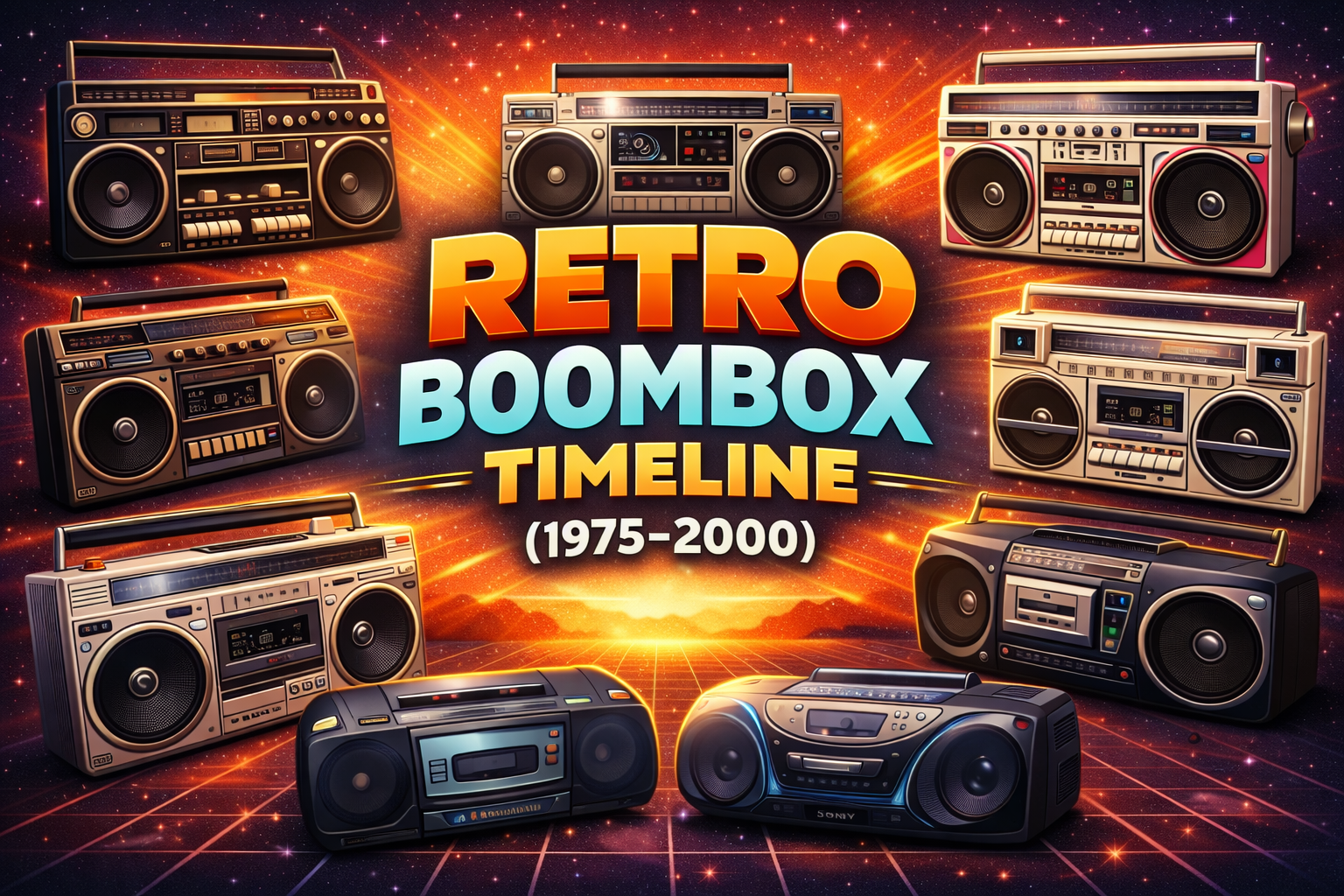
Retro Boombox Timeline (1975–2000)
Boomboxes became cultural icons during the late 1970s and 1980s, representing music freedom, street culture, and portable sound. From early cassette-based units to powerful dual-speaker systems, boomboxes defined an era of personal audio and remain highly collectible today.
This timeline highlights the most influential retro boombox models, their manufacturers, and release years.
Late 1970s: The Birth of the Boombox Era
The late 1970s introduced large portable cassette systems that allowed music to be played anywhere.
| Year | Boombox Model | Manufacturer | Category | Notes |
|---|---|---|---|---|
| 1975 | GF-909 | Sharp | Boombox | Early large portable stereo |
| 1976 | TR-653 | Panasonic | Boombox | One of the earliest cassette boomboxes |
| 1977 | C-100F | Sanyo | Boombox | Popular portable cassette radio |
| 1978 | CF-580 | Sony | Boombox | High-quality early stereo system |
| 1979 | RC-550 | JVC | Boombox | Popular late-70s model |
These early units laid the foundation for the boombox boom of the 1980s.
Early 1980s: The Golden Age Begins
Boomboxes became larger, louder, and more feature-rich.
| Year | Boombox Model | Manufacturer | Category | Notes |
|---|---|---|---|---|
| 1980 | TRC-931 | RadioShack | Boombox | Iconic street-style design |
| 1981 | RC-M90 | JVC | Boombox | Considered one of the best boomboxes ever made |
| 1982 | GF-777 | Sharp | Boombox | Legendary dual cassette system |
| 1983 | M-X920 | Toshiba | Boombox | Large speaker design |
| 1984 | FH-7 | Sony | Stereo Boombox | Modular home-style system |
These models helped define the boombox look most people remember today.
Mid-1980s: Bigger, Louder, and More Powerful
Manufacturers competed to produce larger and more powerful units.
| Year | Boombox Model | Manufacturer | Category | Notes |
|---|---|---|---|---|
| 1985 | RX-5350 | Panasonic | Boombox | Highly recognizable 80s design |
| 1986 | GF-9494 | Sharp | Boombox | Large dual-speaker stereo |
| 1987 | TRC-975 | Lasonic | Boombox | Popular hip-hop era model |
| 1988 | CSD-880 | Aiwa | Boombox | Compact stereo option |
| 1989 | PH-80 | Hitachi | Boombox | Portable mid-size stereo |
This period represents the peak popularity of boombox culture.
1990s: Compact Designs and Digital Features
Boomboxes became smaller while introducing new features.
| Year | Boombox Model | Manufacturer | Category | Notes |
|---|---|---|---|---|
| 1990 | CSD-EX10 | Aiwa | Boombox | Compact modern design |
| 1991 | CFD-560 | Sony | Boombox | Included CD playback |
| 1993 | RX-DT75 | Panasonic | Boombox | CD and cassette combo |
| 1995 | CFD-770 | Sony | Boombox | Digital radio features |
| 1998 | RX-ED50 | Panasonic | Boombox | Modernized portable stereo |
The 1990s transitioned boomboxes into digital media systems.
Late 1990s–2000: The End of the Classic Boombox Era
Portable CD players and MP3 players began replacing cassette-based systems.
| Year | Boombox Model | Manufacturer | Category | Notes |
|---|---|---|---|---|
| 1999 | CFD-S300 | Sony | Boombox | CD-focused system |
| 2000 | RX-ES25 | Panasonic | Boombox | Late-era hybrid system |
These devices marked the transition to modern digital audio.
Most Influential Retro Boombox Models
Certain models became legendary due to sound quality, design, or cultural impact.
JVC RC-M90 — Widely considered the most iconic boombox
Sharp GF-777 — Famous dual cassette powerhouse
Lasonic TRC-975 — Hip-hop culture icon
Panasonic RX-5350 — Recognizable classic design
Sony CF-580 — Early high-quality stereo unit
These models remain highly collectible.
Why Retro Boomboxes Are Still Popular
Retro boomboxes remain popular for several reasons.
Strong nostalgia appeal
Unique industrial design
Analog sound quality
Collector value growth
Cultural significance
Many collectors restore and display these devices.