
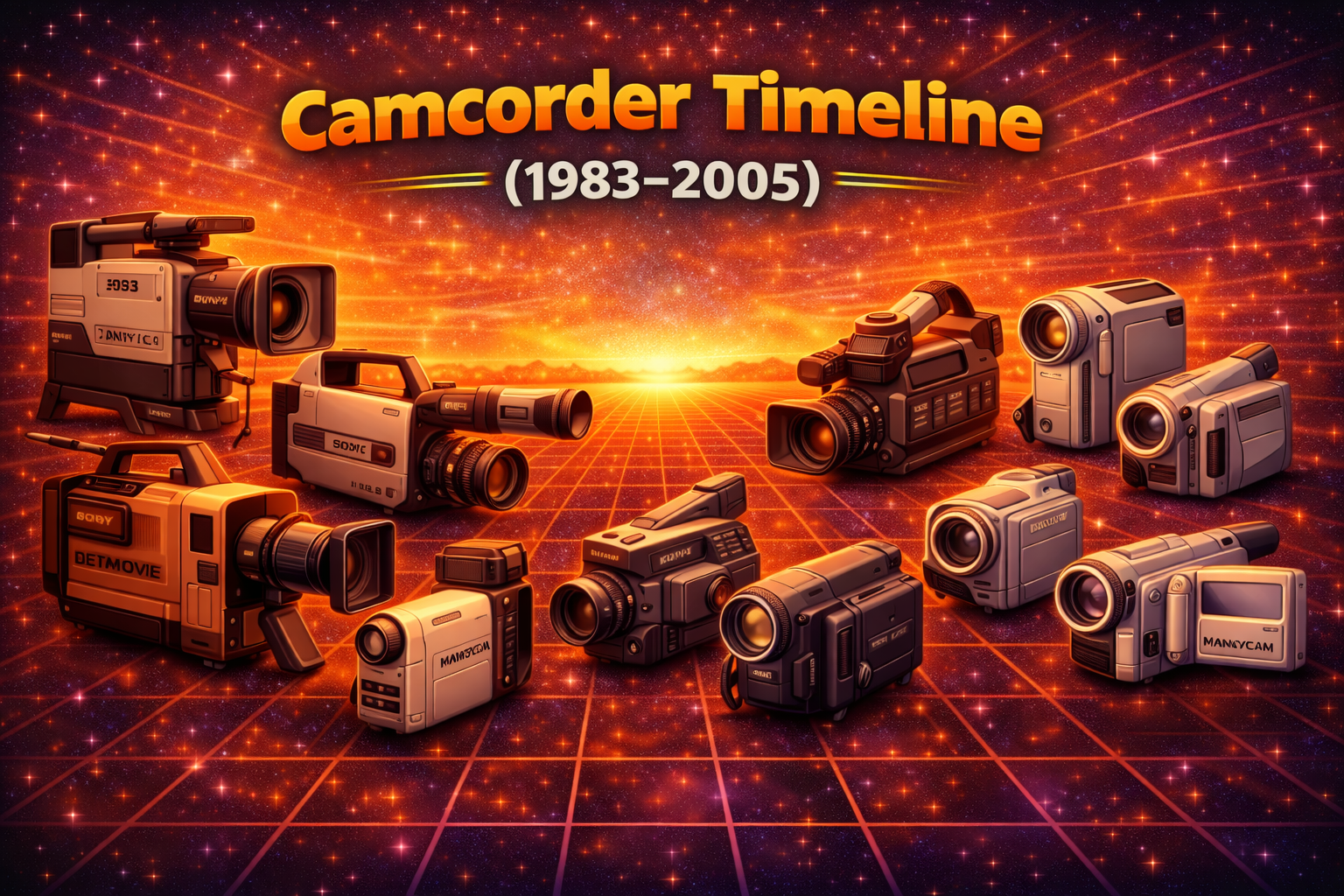
The Complete Retro Camcorder Timeline (1983–2005)
Camcorders changed how families recorded memories, making home video recording accessible to everyday users. From bulky shoulder-mounted units to compact handheld camcorders, these devices helped define home media culture from the 1980s through the early 2000s.
This timeline highlights major retro camcorders, their manufacturers, and release years.
Early 1980s: The Birth of Consumer Camcorders
Early camcorders combined video cameras and recorders into a single portable device.
| Year | Camcorder Model | Manufacturer | Category | Notes |
|---|---|---|---|---|
| 1983 | Betamovie BMC-100 | Sony | Camcorder | First consumer camcorder |
| 1984 | GR-C1 | JVC | Camcorder | Popular early VHS camcorder |
| 1985 | Handycam CCD-M8 | Sony | Camcorder | Early compact camcorder design |
| 1986 | PV-100 | Panasonic | Camcorder | VHS recording system |
These devices launched the home video revolution.
Late 1980s: Compact Designs Become Popular
Manufacturers began producing smaller, more portable camcorders.
| Year | Camcorder Model | Manufacturer | Category | Notes |
|---|---|---|---|---|
| 1987 | CCD-V8 | Sony | Camcorder | Widely used VHS camcorder |
| 1988 | GR-C7 | JVC | Camcorder | Compact VHS-C system |
| 1989 | VM-D51 | Hitachi | Camcorder | Improved portability |
Camcorders became more accessible to households.
Early 1990s: VHS-C and Hi8 Growth
Video quality and portability improved significantly.
| Year | Camcorder Model | Manufacturer | Category | Notes |
|---|---|---|---|---|
| 1990 | CCD-TR5 | Sony | Camcorder | Popular consumer camcorder |
| 1991 | GR-SXM240 | JVC | Camcorder | VHS-C camcorder expansion |
| 1992 | VM-H70 | Hitachi | Camcorder | Improved video clarity |
| 1993 | CCD-TR101 | Sony | Camcorder | High-quality recording system |
Camcorders became standard household devices.
Mid–Late 1990s: Digital Camcorders Arrive
Digital video formats began replacing analog systems.
| Year | Camcorder Model | Manufacturer | Category | Notes |
|---|---|---|---|---|
| 1995 | CCD-TRV65 | Sony | Camcorder | Popular mid-90s camcorder |
| 1996 | GR-DVL300 | JVC | Digital Camcorder | Early MiniDV technology |
| 1997 | VL-AH151 | Sharp | Camcorder | Compact handheld unit |
| 1998 | DCR-TRV900 | Sony | Digital Camcorder | Professional-level MiniDV |
Digital recording marked a major transition.
Early 2000s: The Digital Video Era
Digital camcorders became smaller and more advanced.
| Year | Camcorder Model | Manufacturer | Category | Notes |
|---|---|---|---|---|
| 2000 | DCR-PC110 | Sony | Digital Camcorder | Compact digital camcorder |
| 2001 | GR-DVM70 | JVC | Digital Camcorder | Advanced MiniDV features |
| 2002 | PV-DV953 | Panasonic | Digital Camcorder | High-end consumer camcorder |
| 2004 | ZR85 | Canon | Digital Camcorder | Consumer digital recording |
| 2005 | DCR-HC90 | Sony | Digital Camcorder | Late-era MiniDV camcorder |
These devices marked the transition toward digital video recording.
Most Influential Retro Camcorders
Some camcorders defined the home video era.
Sony Betamovie BMC-100 — First consumer camcorder
JVC GR-C1 — Early VHS recording system
Sony Handycam Series — Popular household camcorder line
Sony DCR-TRV900 — Professional MiniDV camera
Canon ZR Series — Consumer digital camcorder expansion
These models remain recognizable today.
Why Retro Camcorders Are Popular Again
Vintage camcorders are seeing renewed interest.
Key reasons include:
Retro video aesthetics
Analog video nostalgia
Home video digitization projects
Collector demand
Creative filmmaking uses
Many creators now use vintage camcorders for unique video styles.