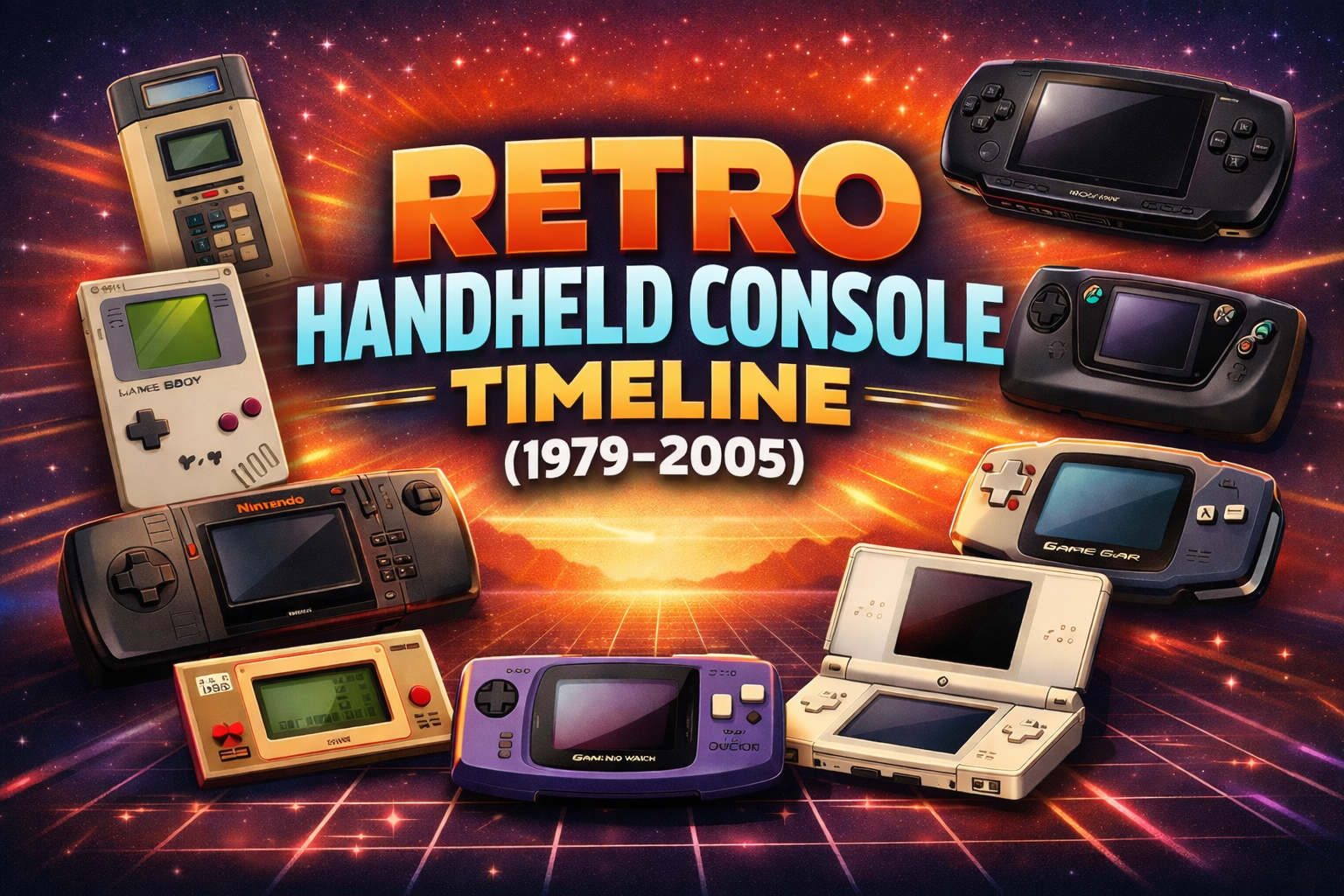
Retro Handheld Console Timeline (1979–2005)
Handheld gaming transformed video games from a home-only experience into something portable and personal. From early LCD handhelds to powerful portable gaming systems, these devices defined generations of gamers and remain highly collectible today.
This timeline highlights the most important retro handheld consoles, their manufacturers, and their release years.
Late 1970s–Early 1980s: The Birth of Handheld Gaming
The earliest handheld systems were simple, battery-powered devices with built-in games.
| Year | Handheld Console | Manufacturer | Generation | Notes |
|---|---|---|---|---|
| 1979 | Microvision | Milton Bradley | First Generation | First cartridge-based handheld console |
| 1980 | Game & Watch Series | Nintendo | First Generation | Introduced portable LCD gaming |
| 1982 | Entex Adventure Vision | Entex | First Generation | Early cartridge handheld |
| 1983 | Vectrex (portable-like system) | General Consumer Electronics | First Generation | Vector display technology |
These devices proved that gaming could be portable.
Mid–Late 1980s: Handheld Gaming Becomes Popular
The late 1980s introduced handheld systems that became household names.
| Year | Handheld Console | Manufacturer | Generation | Notes |
|---|---|---|---|---|
| 1984 | Game Pocket Computer | Epoch | Second Generation | Early cartridge handheld |
| 1986 | Sega LCD Handheld Series | Sega | Second Generation | Standalone LCD games |
| 1989 | Game Boy | Nintendo | Third Generation | One of the most successful handhelds ever |
| 1989 | Atari Lynx | Atari | Third Generation | First color handheld console |
The Game Boy dominated this era.
Early 1990s: Color Screens and Improved Performance
Technology improved, allowing better graphics and sound.
| Year | Handheld Console | Manufacturer | Generation | Notes |
|---|---|---|---|---|
| 1990 | TurboExpress | NEC | Fourth Generation | Portable TurboGrafx system |
| 1991 | Game Gear | Sega | Fourth Generation | Full-color portable gaming |
| 1993 | Mega Duck | Welback Holdings | Fourth Generation | Lesser-known Game Boy competitor |
These devices introduced advanced portable gameplay.
Late 1990s: The Handheld Renaissance
The late 1990s brought some of the most beloved handheld systems ever created.
| Year | Handheld Console | Manufacturer | Generation | Notes |
|---|---|---|---|---|
| 1996 | Game Boy Pocket | Nintendo | Fourth Generation | Smaller redesign of Game Boy |
| 1997 | Game.com | Tiger Electronics | Fourth Generation | Early touchscreen features |
| 1998 | Game Boy Color | Nintendo | Fifth Generation | Color gaming revolution |
| 1999 | Neo Geo Pocket Color | SNK | Fifth Generation | Cult-favorite handheld |
| 1999 | WonderSwan | Bandai | Fifth Generation | Popular in Japan |
Handheld gaming expanded globally during this period.
Early 2000s: Handheld Gaming Evolves Rapidly
The early 2000s introduced powerful handheld systems capable of complex games.
| Year | Handheld Console | Manufacturer | Generation | Notes |
|---|---|---|---|---|
| 2001 | Game Boy Advance | Nintendo | Sixth Generation | Major handheld advancement |
| 2003 | Game Boy Advance SP | Nintendo | Sixth Generation | Foldable design innovation |
| 2004 | Nintendo DS | Nintendo | Seventh Generation | Dual-screen system |
| 2004 | PlayStation Portable (PSP) | Sony | Seventh Generation | Console-quality portable gaming |
| 2005 | Game Boy Micro | Nintendo | Seventh Generation | Ultra-compact handheld |
This era defined modern handheld gaming.
Most Influential Retro Handheld Consoles
Some handheld devices had a massive cultural impact.
Nintendo Game Boy — Defined portable gaming
Game Boy Color — Introduced color handheld gaming
Game Boy Advance — Expanded portable game complexity
Nintendo DS — Revolutionized dual-screen gameplay
Sony PSP — Introduced console-quality handheld gaming
These handhelds remain popular among collectors.
Why Retro Handheld Consoles Are Still Popular
Retro handheld gaming continues to grow due to nostalgia, portability, and collectible value.
Major reasons include:
Portable gaming convenience
Strong nostalgia appeal
Large classic game libraries
Collector demand
Resale value growth
Many original handheld consoles remain fully functional decades after release.